Welcome to San Marino

The San Marino Bioethics Committee is honored to invite you to the 14th Global Summit of National Ethics Committees – CRISIS, EVOLUTION, GROWTH, together with the World Health Organization and in close collaboration with UNESCO

Invitation from the President
THE GLOBAL SUMMIT

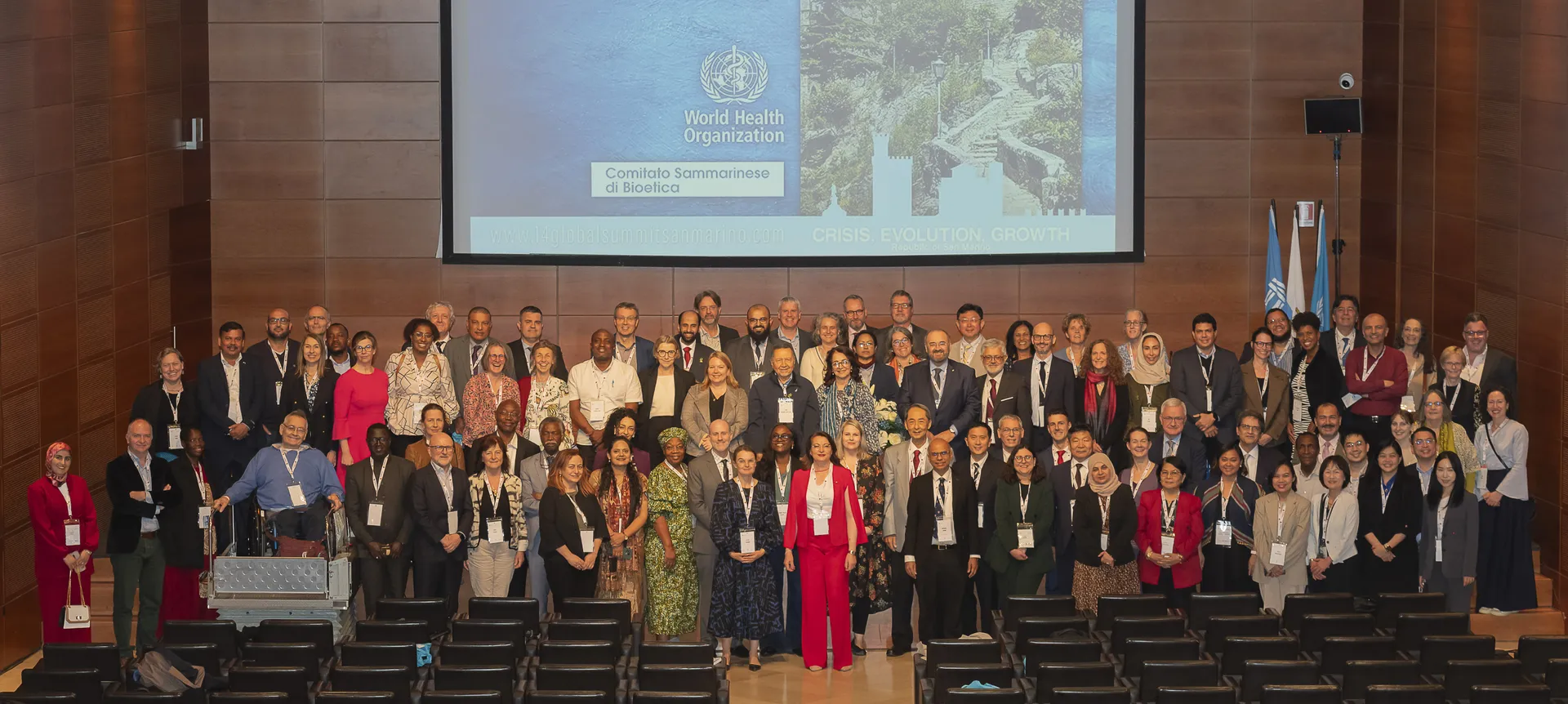
Every two years, the Global Summit of National Ethics Committees brings together representatives from National Ethics and Bioethics and other advisory bodies from countries all over the world for an event of seminal strategic importance, representing a unique opportunity to foster international debate and to build consensus on priority issues of global interest in the fields of Bioethics.

  • Luisa Borgia
  • Mohammed Alkawi
  • Adioilde Aguiar
  • Godfrey Biemba
  • Maria do Céu Patrão Neves
  • Dafna Feinholz
  • Aamir Jafarey
  • Katherine Littler
  • John Mcmillan
  • Gurung Mongal Singh
  • Rintis Noviyanti
  • Virginie Pirard
  • Andreas Reis
  • Mariano Soriano
  • Giorgio Cantelli Forti
  • Massimo Di Muzio
  • Giampiero Griffo
  • Patrizia Hrelia
  • Lorenzo Montrasio
  • MICE Team
  • Eduardo Capobianco
  • Cíntia Águas

The objectives of the Global Summit are

To bring together the National and International Ethics/ Bioethics Committees / Commissions / Advisory Bodies from around the world in relation to bioethical issues

To serve as an international forum for exchanges and debate on bioethical issues of common global interest, based on a state of the art of the chosen topics

To contribute both to common understanding and consensus building between nations

To provide the space and opportunity to convene regional forums of National Ethics/Bioethics Committees

Patronages

European Disability Forum
Rtv San Marino
coe

CRISIS, EVOLUTION, GROWTH:

CONTRIBUTIONS AND CHALLENGES OF NATIONAL ETHICS COMMITTEES IN A WORLD OF UNCERTAINTY

In recent years, the number of human and natural disasters has grown exponentially. At the same time, we have been observing the increasingly intense consequences of global warming on our world, and the resulting disruption to our societies. This disruption has been further compounded by the COVID-19 pandemic. This is leading to greater uncertainty: uncertainty about available resources, about geopolitical balances, about the very future of the human species and of biodiversity on our planet.

Consequently, it is timely to reflect on how National Ethics and Bioethics committees can play an active role at the forefront of speaking to and addressing these challenges facing our respective societies. This conference will focus on four key areas of crisis.
Preparing for crises in times of resource shortages:role of National Ethics Committees

The right to food has long been acknowledged as a fundamental human right. Climate change, the COVID-19 pandemic, recent conflicts are some of the major drivers that have intensified issues of food insecurity. Many of the same drivers are also seeing changes to food production and supply which has already been under intense pressure due to a myriad of issues, including the globalization of food production. This is making it increasingly difficult to ensure food safety. Rethinking our approach to food systems will need to respond to issues of sustainability, equity and healthy living

Parallel session: Issues of crisis: pandemic preparedness

The COVID pandemic forced governments, policy makers, regulators, and the health and research communities to innovate and to find rapid solutions. National Ethical Committees (NECs) across the world assisted in the response, through the development of guidance and policies. With the pandemic behind us, there are many lessons we need to take forward, not only to prepare us for future public health emergencies but also to allow us to deal with the uncertainty, scarcity and
instability associated with other types of crises, from natural disasters through to mass migration and climate change. Some of the most important questions are: what are the concepts, theories and methodologies, and guidelines that NECs have developed during Ebola, Zika and COVID-19 that we can take forward into future crises? What are some of the preparedness activities foreseen or already underway to deal with other types of crises?

Contributions and challenges of National Ethics Committees in fostering inclusion for persons with disabilities and vulnerable groups

The approval of the United Nations Convention on the Rights of Person with Disabilities (CRPD) has changed the vision about persons with disabilities, moving from a medical model towards the social model of disability based on the respect of their human rights. It has provided a transformative approach to ethical practice in many areas, including in terms of preparedness for emergencies, access to healthcare and changes to disability research. Evaluation and understanding the relationship between vulnerability and disability, understanding the impact of the CPRD, reflecting on its application in different settings, is critical to understanding future approaches.

Parallel session: Inclusion, exclusion and ‘vulnerability’

Vulnerability among populations often arises from factors beyond their control. Political instability, economic challenges, social and educational background, environmental disasters whether linked or not to climate change, evolving social and cultural determinants are among these factors. In times of crises, inequalities and marginalization increase, and new types of vulnerabilities emerge. Researching and working with these populations is crucial to comprehend and address these challenges. National Ethical Committees (NECs) play a pivotal role in exploring and addressing the different types of vulnerability that have arisen and will
continue to arise in future crises, safeguarding against exploitation and promoting fairness in health, research and policy development concerning issues of vulnerability. It is important to both capture this long-term experience but also to benefit from new approaches and new resources, e.g., from the disability field, as identified in the main plenary session.

Striving for equity in the face of medical innovations:how can National Ethics Committees help redress the balance?

Catastrophic events caused by natural and human phenomena require critical decision-making processes in which fundamental ethical values come into play. Facing such events requires the involvement of human and technical resources and the availability of functioning systems to prevent, prepare for, and mitigate their effects,. Consideration of fundamental ethical principles and local cultural diversity, is critical to understanding the issues associated with the introduction of innovative technologies for all elements of medical countermeasures in our response to crises?

Parallel session: Equitable access and benefit sharing: prevention, diagnosis and treatment, adapting resources to unforeseen challenges

In an era marked by global health crises and rapid scientific advancements, the lack of access to vaccines during the COVID-19 pandemic by many LMICs emphasized the issues of equitable access and global health justice more broadly, reinforcing the need for solidarity. Adapting medical innovations to local settings to ensure effective, accessible, and culturally appropriate healthcare solutions will be crucial for Universal Health Coverage. Ensuring that already available diagnostics, preventative measures and treatments are equally accessible in low-resource settings, remains a fundamental challenge. These challenges are global in nature but also local in impact. National Ethical Committees (NECs) have played a key role in taking stock of these trends and challenges. What can and should the role be of NECs in fostering equitable access at the national and international levels?

The role of National Ethics Committees in promoting public engagement, dialogue, and trust in public health and welfare

During the COVID-19 pandemic crisis, citizens and decision-makers sought solutions in science. At a time when biological and medical research has succeeded in creating new and adapted vaccines to prevent serious disease, trust towards both public institutions and policy makers has been challenged. The rise in disinformation and misinformation was also well documented during the pandemic, magnified via social media platforms and resulting in an infodemic. Governments, health agencies and public officials will need to rethink future models of both communication and engagement and the principles that must underpin them.

Parallel session: Trust, misinformation and engagement

Crises raise all forms of profound societal challenges. Some of the solutions to these challenges lie in science. COVID-19 was an exemplar of this, but it also highlighted the profound complexities associated with building this evidence base, uptake and delivery of scientific solutions. It is clear that knowledge gaps exist which lead to uncertainty. The role of uncertainty in the response to crises needs to be better understood and communicated. NECs not only play a vital role in providing ethical guidance; they are also key in raising awareness and informing public opinion and fostering trust in science and evidenced-based
decision-making. This is of particular importance in times of crises, where misinformation and disinformation abound, magnified via social media platforms, creating ‘infodemics’, which impact trust and acceptance of public health measures. What role have NECs played in exploring this complex nexus, and what kind of approaches do they advocate? What role do they need to play going forward, and what other issues do they need also to consider?